Thursday, March 7, 2019

RootsTech 2019: Part 3

RootsTech 2019 was so full that I couldn't get it all in with just one post. Part 1 covered Wednesday and Thursday, and Part 2 covered Friday.

This will be the third and final post in my series on RootsTech 2019. It will cover the last day of RootsTech, Saturday 2 March, as well as my adventures in Salt Lake City on Sunday!

Though I was sad to miss the first Saturday of Souls liturgy during RootsTech, it was fitting that it was because I was at RootsTech working on my genealogy skills! To learn more about the Orthodox Christian remembrance of the departed, you can check out this great resource. Also, check out my Four Reasons Behind My Blog's Name to see the importance of remembering our departed loved ones in the Orthodox Church.


Our keynote speaker - and entertainer - was Japanese-Hawaiian ukulele player Jake Shimabukuro. He was a blast! There were moments where I thought, "I didn't know a ukulele could hit that note!" It was awesome to see a musician so much in his groove, getting into his music. During his keynote speech, he shared several nuggets of wisdom for us:

  • “I am what I am because of you.” What a beautiful Japanese phrase!
  • “Lose to win.” You lose for someone else’s win. Someone else’s sacrifice made our present reality possible.
  • “In music it is so important to feel. If you don’t attach a meaning to every note, you’re not making music. You’re just making sound.”
  • “Music is pure emotion.”
  • “The purpose of memory is not only to remember the past but to better predict the future.”
  • “Make a sacrifice to give someone else the opportunity to be grateful.”
  • “We owe a great debt to those who came before us.”
  • Message for youth: 
    • Study hard. 
    • Find your passion. 
    • Practice! 
    • There are times it’ll get tough. Push through and you’ll come out a tougher person. 
    • Be drug free. 


Scott Fisher from Extreme Genes having a laugh with Jake Shimabukuro during his interview.


The Media Hub was a great place to visit with other bloggers - who were part of RootsTech Ambassadors - as well as speakers at the conference.


I even got to meet Ali, the winner of my RootsTech pass giveaway! 


Here's the whole group of Ambassadors for RootsTech 2019! What a great group; am I right?!

Here is my schedule from Saturday:

Saturday
  • 9:30am - Finding Substitutes for Vital Records – Peggy Clemens Lauritzen
  • 11:00am - General Session: Jake Shimabukuro
  • 1:30pm - Census Sense: Clues and Conundrums for Intermediate Researchers – Patti Gillespie
  • 3:00pm - It’s Called FAMILY History: Top Tips for Collaborating with Living Family Members – Crista Cowan & Stephen Cowan


After RootsTech was finished, I headed north to South Ogden for a Greek "Apokreas" Dinner at Holy Transfiguration Greek Orthodox Church. An apokreas or apokreatiko dinner is the Greek equivalent (both linguistically and culturally) to the Carnival. It marks the end of eating meat before Great Lent begins. Since Great Lent is a time when Orthodox Christians abstain from meat and dairy products, we have a week prior when we can still eat dairy products, as a way of easing into the fast. So an apokreatiko night is a way to get rid of the meat products in the home, and also to have one last celebration before the great feast of Pascha (Easter).

It was great to reconnect with my friends who are members of Holy Transfiguration, and I had a great time enjoying the hospitality of their community! 


On Sunday morning, I headed back downtown to Saints Peter and Paul Orthodox Church for the Divine Liturgy. What a lovely community! Everyone was so welcoming, and I felt that they were truly embracing the entire city in their hospitality. They even recited the Our Father in EIGHT languages: English, Slavonic, Spanish, Portuguese, Romanian, Georgian, Serbian, and Greek. They may have said it in Arabic too, but I can't recall. The sermon was right on point too and since it was the Sunday of the Last Judgement (Matthew 25), we heard about the importance of our actions in the Christian life. A beautiful - and indeed convicting - message.


Isn't this a beautiful worship space?!


AND they have seven catechumens (people who are studying the Orthodox Christian faith to be received into the Church by baptism and/or chrismation)! Such an active community!


After the Divine Liturgy - and the delicious lunch following in the church hall - I headed out for coffee with a genealogy friend of mine. I even got to see AncestryProGenealogists headquarters! AH! SO COOL! 


Sunday night, I had the absolute pleasure of having dinner with the family of my third cousin, Autumn! She shares my Vaughan & Ogburn family line from Dinwiddie and Brunswick counties in Virginia. We got to know each other better over a tasty table of tacos, and then chatted over old family photos and ice cream. What a fun evening! Here's a photo of me and Autumn in the Expo Hall at RootsTech.

After dinner with my cousins, I was back to the airport and my journey brought me back to Virginia in the wee hours of Monday. RootsTech 2019 was an absolute blast! I'm so grateful that I was able to attend, and I'm honored to have served as an Ambassador this year. The RootsTech staff made this year so smooth and successful, from registration to class size, to the class schedule to the entertainment. 


RootsTech is a big conference. But do you ever wonder just how big *big* is when it comes to RootsTech? RootsTech 2019 At A Glance sure does put it into context. You can read more about the stats in RootsTech in Review here.

Did you make it to RootsTech 2019? Don't forget to rate your courses on the RootsTech app! The instructors will certainly appreciate the honest feedback so that they can continue to improve their lessons.

*****

RootsTech 2019 has come and gone. It brought me tons of new ideas, new friends, great connections, 28 pages of notes, new books, a MyHeritage beanie, and the conviction that I've *got* to get my certification and/or accreditation as a professional genealogist. 

I'm committed! My ancestors - and your ancestors - deserve the best researcher, the most passionate story-teller, and the dignity of being remembered.

So let's keep encountering our ancestors through family history and remembering the past made present today!

RootsTech 2019: Part 2

RootsTech 2019 was jam-packed with classes, opportunities to network with other genealogists, and even a little time to do research at the Family History Library! In RootsTech 2019: Part 1, I shared my first two days of RootsTech with you. This post will cover Friday, 1 March.

On Friday, my day began bright and early with the MyHeritage Friends Breakfast. It was great to hear from MyHeritage Genealogy Expert Daniel Horowitz about all the new things MyHeritage is offering and working on. Plus, it was a chance to enjoy some delicious food with new friends. We had to keep their announcements a secret until they were public at the General Session, but here is the news from MyHeritage!

  • AutoClusters to organize your DNA matches
  • Theory of Family Relativity - incorporate genealogical information with DNA matches
  • Free webinars every Wednesday
  • DNAQuest renewal for 5,000 free DNA tests to adoptees! If you're adopted and looking for biological family, this is for you! Registration is open now: http://dnaquest.org
To get more information about MyHeritage and their new features check out their blog post about RootsTech.


Saroo Brierley, author of his memoir A Long Way Home (adapted into the 2016 film Lion), was our keynote speaker on Thursday! I was SO excited! He spoke about his story of getting lost in India, his adoption by a family in Tasmania, Australia and his eventual reunion with his biological family. It was a great talk! I loved reading his memoir, and was thrilled to ask him my question in person.


"One of the parts that was most moving for me in your book was when you were talking about a moment you had with Baba, the religious leader in your village. I work full-time with youth for my church, so that influence that you can have with young people is really important to me. And one of the things that you said is that he fed not only your body, but also your spirit because he gave you hope that you were - you know - a person that had meaning. So how has that influence of Baba still brought into your life, and have you brought that into other aspects of your life?"

"You are the first person to ask that question. And it's a very important question to me. Because when my mother wasn't about - my biological mother - I would be taken to the holy man and he would take me fishing, he would show me around. And you know, I spent a lot of time with him. And I think he had a massive influence on me, of the way to look at nature, and so on, and spirituality. And this movie's got a massive spirituality in it. Because, I'm not too sure, but I do get a little bit from my mum, my adoptive mother, and my biological mother is quite spiritual as well. And, you know, to deny would be just like well you know it's not like that. Somehow, I've had that influence, evidently it was through the holy man. And, that's just the way it was, so I don't know what else to say. But, I think I've very privileged to be in the arms of someone that wanted to take care of me when my mother wasn't around."


Here's another view of the interview set-up at the Media Hub. Thank you to @easygenie for the shot!


I got a selfie with Saroo and Tierra from Pressing My Way. We were pretty happy!


I also got Saroo Brierley to autograph his book!


One of the class highlights of the day was from The Research Road Map: Your Path to Success by Amy Johnson Crow. Here are some of the take-aways from her talk:

Before we can know what road to take in our genealogy research plan, we need to know where we are now. So some things to think about are:
  • What notes can we reread? 
  • What sources do we already have? 
  • We need to find holes in our research. Don't assume they aren't there!
Here are a couple helpful quotes from her talk too:
  • "Is there something better you can use for this particular fact? If so, finding that source needs to be part of our research plan.”
  • "Information you read is only as accurate as the knowledge of the person who gave it."
  • "Our ancestors are more than names!"
I was also happy to get to meet Jennifer Mendelsohn of #resistancegenealogy fame! You can follow her on Twitter @CleverTitleTK. I found her at the booth of another great group that works to make sure we all have access to our records, Reclaim the Records. Please make sure to support their work!

As if that wasn't a full enough day, I also had a meetup with the Virtual Genealogical Association Thursday night! It was great to have an in-person get together with people who gather virtually around the country.  

Here is my schedule from Friday:

Friday
  • 7:00am - MyHeritage Friends Breakfast
  • 9:30am - Essential Considerations for DNA Evidence - Blaine T. Bettinger
  • 11:00am - General Session: Saroo Brierley
  • 12:50pm - Interview with Saroo Brierley
  • 1:30pm - Chromosome Mapping Tips and Techniques - Blaine T. Bettinger
  • 3:00pm - Colonial New England Research and Resources From Archives to the Internet - David Allen Lambert
  • 4:30pm - The Research Road Map: Your Path to Success - Amy Johnson Crow
  • 6:00pm - Virtual Genealogical Association - Meetup

*****

Friday was amazing. So many memories, great classes, new connections.

My next post will be about the last day of RootsTech 2019 and an eventful Sunday in Salt Lake City!

Let's keep encountering our ancestors through family history and remembering the past made present today!

RootsTech 2019: Part 1


RootsTech has come and gone! It seemed to fly by, yet each day was filled with so much good stuff, it was impossible to blog about it during the event itself.

There's still so much to say and so little time, so let me share tidbits of all the great things that went on. Some of this post will be announcements of new and exciting features of genealogy websites, others will be of genealogy related news. Then, I'll include some of the fun connections I made over the week.


On Wednesday, we heard from Michael B. Moore, the CEO and President of the coming International African American Museum in Charleston, SC. This museum will be one of a kind, being set on the site of “the Ellis Island” of African Americans - the port where nearly half of all enslaved Africans entered the United States. It will be a place for the African American community to connect to their past, and find pride in their offering to our nation’s history. It was also announced that the Church of Jesus Christ of Latter-day Saints is gifting $2 Million for the IAAM Center for Family History


Then, we heard from Martin Luther King III. As in the son of Martin Luther King, Jr.! WHOA!

He shared that “a community at peace with itself" was the goal of Martin Luther King Jr’s dream. He then shared that this peace, along with community reconciliation and redemption, were the result of family history research! How cool is that? Martin Luther King II also shared that the IAAM will help African Americans “feel the healing connections of family and faith.”

On Thursday, the CEO of Ancestry Margo Georgiadis made several announcements!

  • MyTreeTags: allows you to add tags to individuals in your tree
  • New DNA matches tool - coolest thing is it allows you to add colored dots to matches!
  • ThruLines - replaces circles with some cool potential ancestor features
  • Addition of new content in 12 states, immigration, military 
  • Searchable obituaries
  • New worldwide records 
  • Updated African American communities


The keynote for Thursday was Patrica Heaton. She shared several great nuggets of wisdom that came from her experience as an actress and mother. “Families bring you down to earth and test your character,” she told the audience. “If I had to choose between a career in acting or children, I’d choose children every time.” At one time, she had hoped to work with an orphanage in Mexico, but Heaton believes that God gave her an acting career so that she could give back to others in His own time. She concluded that “We’re all connected. We need to focus on the connections and not the differences.” Thankfully, family history research does just this; it connects us and helps us see past these differences.


And then came my moment to ask Patrica Heaton a question! Here it goes!

"You spoke about the fidelity of your family and how that helped keep you supported. So my question to you is this. My friend Ted is from Twinsburg and Cleveland Heights and he says that a Cleveland Browns fan is the most faithful of people. So my question for you is: are you a Cleveland Browns fan?"

"Yes. Well, my father covered the Browns for 25 years as a sports writer and he's in the football hall of fame. And we had our childhood vacations at the training camp in Hiram, Ohio. Hiram College is where they used to train. So that's what we'd do; we'd go and my dad would plunk us there and our family vacation was watching the Browns do scrimmages and then going on the field afterwards and playing on the equipment and then eating with the players. So, it's kind of in my blood. It's our cross to bear. But it builds character!"

"And you bear it well!"

"Thank you!"

"Ted Cherpas says hello."

"Okay great, thanks!"


And if hearing MLK III and then speaking with Patricia Heaton wasn't enough for one day, I got to listen to Lisa Joyner and Chris Jacobs of Long Lost Family too! They shared some of their own adoption stories as well as their favorite moments from the show. Lisa said she hopes that one of the results of this show is to destigmatize birth mothers of adoptees. So often, people blame birth mothers without seeking to see the complex situations they found themselves in. 

During the Q&A, I had the chance to be the first question to Lisa and Chris. I opened by mentioning that I have had the honor and great responsibility of sharing news about birth parents to adoptees and individuals with misattributed parentage. Since this is what they do every episode, how do they balance the need for good television with the ethics surrounding providing such sensitive information to real people? Lisa told me that the show has psychologists to both guide them and to be there for participants on the show. She reassured the audience that they treat each person individually with their particular needs. It was good to know that both Lisa and Chris, as well as the crew at Long Lost Family take serious the need to provide proper counseling to those who invite us into such sensitive moments in their lives.


Then there's the classes! Wednesday classes began at 9:30am and the last event ended at 5:30pm, while starting Thursday the days began at 8:00am. This year, they added "Power Hour" at 8:00am to hear from multiple speakers on a shared topic. The format was sort of like a TED Talk in that each person spoke more briefly and focused on nuggets of information.

Here is my schedule for Wednesday and Thursday:

Wednesday
  • 9:30am - Deeper Analysis: Techniques for Successful Problem Solving - Elissa Scalise Powell
  • 11:00am - The surname is key: History of surnames and conducting surname research in Germany - Dirk Weissleder
  • 12:15pm - Everyone has a story, even you! - Blaine Bettinger & Angie Bush
  • 1:30pm - The Magic of German Church Records - Katherine Schober
  • 3:00pm - Slave Traders, Speculators and the Domestic Slave Trade - Kenyatta D. Berry
  • 4:30pm - General Session: Steve Rockwood, CEO of FamilySearch, & entertainment by The Edge Effect

Thursday
  • 8:00am - Making the Leap – Becoming a Professional Genealogist 
    • Getting Ready to Leap – Valerie Elkins
    • Genealogy as a business – Luana Darby
    • Which Credential? - Anne Teerlink
  • 9:30am - Finding 17th century English Ancestors – Problems and Solutions - Else Churchill
  • 11:00am - General Session: Patricia Heaton
  • 12:50pm - Interview with Patricia Heaton
  • 1:30pm - One Touch Genealogy Research: Handle a Record Just Once - Thomas MacEntee
  • 3:00pm - Ancestry Town Hall: Go behind the scenes of Long Lost Family with Lisa Joyner & Chris Jacobs
  • 4:30pm - The Problem with Porters: Men of the Same Name - Rebecca Whitman Koford
  • 7:30pm - NextGen Meetup


*****

Y'ALL! This is only the first two days! I can't wait to share the rest of the conference!

Check out the photo at the top of this page. It's a group shot of other genealogy bloggers from GeneaBloggers TRIBE. They're awesome folks!

Let's keep encountering our ancestors through family history and remembering the past made present today!

Wednesday, February 27, 2019

RootsTech Eve

I've been waiting for RootsTech 2019 since RootsTech 2018 ended.

No joke, y'all! It was awesome!

So, the day before RootsTech 2019 - RootsTech Eve - was much to be excited about. Last year, somehow I didn't make it to explore the Family History Library. I know, I know...the shame! BUT I have vindicated myself.


This is just one part of *one* aisle at the amazing second floor of the Family History Library. It's organized in the millions. For real, y'all!


My first thoughts were, "we're not in Virginia anymore, Toto!" And then I realized, "I HAVE ARRIVED!" This place is full full full of records. I was grateful to find out that the library uses PowerScan3000. This is a great program used to view microfilm on a computer; you can then save PDF files of the records of your choice to your flash drive. I was already used to using this program at the Library of Virginia, so I was able to get straight to work without needing any assistance.

That reminds me; the Family History Library is FULL - chock-full - of helpers to aide in whatever you might need while on site. Thanks y'all!


Also, you can use one of these fancy - and large - lockers free of charge while at the Library. #winning

After the shock of enjoying the library had just begun to sink in, I realized it was time for lunch. I was able to meet up with professional genealogists for a fun lunch near the temple area and then I headed straight back to the library. On site, I was able to view a lot of digitized records that are only available to view while at a family history center. Super convenient!


As an Ambassador for RootsTech, I was able to meet with other Ambassadors, members of the media, and conference speakers at the Media Dinner. It was great just to chat with others who have been involved in the behind the scenes of the conference, enjoy some fellowship and fun, and a delicious meal to top it off!


I mean look at that! We eat first with our eyes, so RootsTech certainly helped with that. 


We also got to explore some of the different new components to the RootsTech app for this year. The coolest part is the Family History Activities page that you can also reach from your computer browser. 

After dinner, I headed straight back to the Library! I had some help connecting my family tree from my Ancestry account to the FamilySearch Family Tree. FINALLY I got it sorted all out. Now, I can use Find Relatives Near Me! And, you can too!

The beauty of using the "find relatives near me" component of the Family Tree app is that we can connect with cousins in real time where we are now. This can lead to more collaboration and better research! Plus, who doesn't like meeting cousins? I've even found out that I'm cousins with some speakers and Ambassadors I already know!

*****

That's all I have for y'all about RootsTech Eve! I can't wait to tell you about DAY ONE!

Let's keep encountering our ancestors through family history and remembering the past made present today!

Tuesday, February 26, 2019

RootsTech is coming! RootsTech is coming!


I started my trek to Salt Lake City, Utah yesterday at 11:15am. After getting coffee, I headed first to JFK from Norfolk, Virginia and then I was off on my second leg of the journey. So from door to door, the whole trip was about 10 hours. 


I travel light! Well, I would have brought more with me...but I'm too scared of things getting lost! I think I did pretty well though. I fit a whole week's worth of clothes in one carry on! But...when I woke up this morning, I realized I had forgotten something. Something a tad important. Undershirts. UGH! Thankfully, the Salt Palace is next door to a mall! Crisis averted.


The flight from JFK to SLC wasn't too bad. Delta proved a good host and I got a lot of reading done. I was even able to text family and friends in flight with free WiFi! I had never done that before, so it felt a bit surreal to all involved for me to text "I'm flying over Nebraska right now!"


After a long flight...with only plane snacks and a few sodas, I was famished! I found a Mexican restaurant a short 20 minute walk away from my Airbnb so I headed straight there. It was delicious! Tamales, rice and beans. Nom nom!

Well, tonight is the Media Dinner and tomorrow RootsTech begins! I'm excited to be able to explore the Family History Library and to see what mysteries might be answered there. 

Are you prepared for RootsTech? If you're not able to make it, you can live stream some of the conference right from the comfort of your home! If you are making the trip out, here are a few things you can do to make sure you're ready.

*****

Stay tuned for news from RootsTech 2019! I'll be updating everyone with how the conference is going, and the new and exciting discoveries I make while I'm here.

Join me then as I encounter my ancestors through family history and remember the past made present.

Friday, February 8, 2019

Edmonia Harriet Stratton


Some of our ancestors just seem to insist on hiding from us. They show up in records and then disappear. Others leave a nice trail behind them like bread crumbs for us to follow after. Still others beckon for us to dig deeper.

My 2x great grandmother practically demands my attention. Her name jumps out on the page as if to say, "Here I am! Come on now, I have something to share with you!"

Edmonia Harriet Stratton.

So let's not leave her waiting, y'all! She's got something to say!
Edmonia's early years

Edmonia Stratton first makes her appearance in the records in the 1850 U.S. Census for Powhatan County, Virginia. At a year old, she's the youngest - at the time - of her many siblings. She's the youngest girl of her parents David Stratton and Jordenia E Hopkins. Her father was a native of Powhatan, her mother of neighboring Chesterfield County.

Edmonia had twelve older siblings! Her mother was the second wife of David Stratton - the son of a Revolutionary War patriot from the same county. Edmonia's early years were also marked by the paradox of the institution of American slavery - that even family could own family. Her father had inherited an enslaved woman named Sally from his first wife's father. The memory of "Aunt Sally" remains in the family to this day. She bore David a daughter named Kate Stratton, an enslaved woman - and Edmonia's older sister - who remained with Edmonia's family until the day of her emancipation. Whether Edmonia knew that Kate and her children were her sister and nieces and nephews we can only speculate. We do know that the families remained neighbors and were buried in the same family cemetery.

The Stratton family attended Peterville Baptist Church, a local church community with an established Sunday School. David Stratton owned for a time a tavern in the town of Macon in Powhatan County but after the Civil War, he lost the tavern and filed for bankruptcy. Edmonia's sisters married into the Hague family, and one was even a local post mistress!

Marriage and family

When Edmonia was 18 years old, she married Leroy Samuel Wooldridge - a veteran of the Confederate army. Leroy's family descended from an important mining family from Chesterfield County that founded the town of Midlothian. Even after marriage, Edmonia remained a member of her family's church - Peterville - though in time her family became affiliated with Powhatan Baptist Church further east.

From 1869 until 1888, Edmonia bore her husband Leroy eight children. Most of the Wooldridge children remained close to Powhatan - all but two married - and many are buried at Old Powhatan Baptist. But by 1910, her husband is listed as a widower.

Unfortunately, neither Virginia nor Powhatan County kept records of deaths between 1900 and 1910, so there is no vital record of her death. Thankfully, her daughter Mary Susan Wooldridge - my great grandmother - recorded the date of her death in her family Bible.

"Grandma) Harriet Edmonia Stratton - died Sept. 28, 1905."

From Unusual Name to discovery

The more I saw records of my "Grandma Edmonia", the more I wanted to discover more. She passed away at the young age of 57, but her daughter - my "Granny Williams" - lived to be nearly 100. How did she pass away? What happened? Not only was her first name "Edmonia" intriguing, so too was her surname "Stratton." It has always fascinated me and called for me to discover more.

My curiosity to discover more about Edmonia has led me to make the Stratton family one of the most thoroughly researched parts of my family history. I have connected with more Wooldridge-Stratton descendants than probably any of my other family lines. I have been part of the puzzle in helping adoptees discover their roots and I have met long-lost cousins over barbecue and old photographs. These connections have given me priceless gifts like the exact dates of birth of Edmonia and her siblings from their Family Bible. These cousins have shared letters written by Edmonia's brother about the Civil War's affect on his life and his fears for their brother's safety while fighting in the war. What price could you ever place on such goldmines of family history? What gifts!

Births of the Stratton children as recorded in the Bible of Louisa Stratton Hague.

Because of Edmonia, I have newfound family members, ever reminding me that genealogy is always about family: that research without connection, documents without stories, and DNA evidence without relationship is just...data. Edmonia may have passed from this life in 1905, but she keeps inspiring her descendants to stay connected and to actively remain family.

*****

Before I began to research my family history, I had never heard of Edmonia Harriet Stratton. But after I had been introduced to her through the records, she has guided me ever since. I may not know many of the details surrounding her daily life or the cause of her death, but she has been the catalyst for so much of my research.

Though I may not know why the Stratton family chose to name her Edmonia - I am grateful that this unusual (though beautiful) name stands so prominently within my family tree. 

Which of your ancestors' names stands out to you the most? How has an "unusual" name inspired your research?

This post was inspired by the week 3 prompt "Unusual Name" of the year-long series that I'm participating in with Amy Johnson Crow's 52 Ancestors in 52 Weeks.

Join me next time as I encounter my ancestors through family history and remember the past made present.

Friday, February 1, 2019

The Challenge of Endogamy


My Grandma Nora's father was named Grover Steven Hite. He was born between 1890 and 1893 (the verdict is still out as to when he was actually born) in Halifax County, Virginia.

Grover had deep roots in Halifax County, Virginia. In fact, all of his great-grandparents lived in Halifax.

With such a strong connection to one specific place for at least a century, my great grandfather's family is seemingly connected to everyone in Halifax! This connection that he shares with so many people is due to a custom called endogamy. So this post will discuss some of the dynamics I've discovered in my great-grandfather Grover's family and the challenge that endogamy poses to my genealogical research.

1. What's endogamy?

Endogamy is a practice in which communities marry within their own social group, repeatedly over time. This is a custom particularly prevalent within communities such as Ashkenazi Jews, Amish, Mennonites, Native Americans, and Acadians.

Since endogamy affects specific communities more than others, there aren't a ton of writers and speakers on the topic. Thankfully, I was able to go to a great talk by Lara Diamond at RootsTech 2018. So make sure to check out her blog as well as this post which specifically deals with how endogamy affects her genetic genealogical research.

I'd also really recommend you read Endogamy and DNA, a guest blog post by Paul Woodbury over at Kitty Cooper's blog, as well as this post which will further help you to understand the complexity that endogamy adds to researching one's ancestors.

2. Was Grover's family endogamous?

Halifax County can be seen here on the border with North Carolina.

Grover was born to George Berryman Hite and Cordelia Frances Tuck, a pair of first cousins who both grew up in Halifax County. The two shared Reuben Wilkins and Edna Elliott as maternal grandparents. As far as I can tell, this is the only episode of cousin-marrying within his genetic line. But as I research Grover's various cousins within Halifax County, I find repeated examples of them marrying close and distant cousins.

One example was Grover's first cousin, Charlie Edward Hite and his wife Mary Otelia Wilkins. Of this pair's eight grandparents, four of them have the surname Hite. On further investigation, you'd find that these four Hites were all siblings, the children of Spencer Perry Hite and Martha Jane Wilkins of Halifax County, Virginia. Put another way, Charlie Hite's parents were first cousins and Mary Wilkin's parents were first cousins.

The more I research Grover's ancestors, I find that many of their children married cousins. Over and over again, I see four common surnames in Halifax County, Virginia records: Hite, Tuck, Wilkins, Elliott.

3. Endogamy's affect on DNA

As the bloggers have mentioned in the posts I linked to above, endogamy has a clear affect on our use of DNA in our genealogical research. Two individuals from the same endogamous community will undoubtedly share more DNA with each other than your average couple with the same known genealogical relationship.

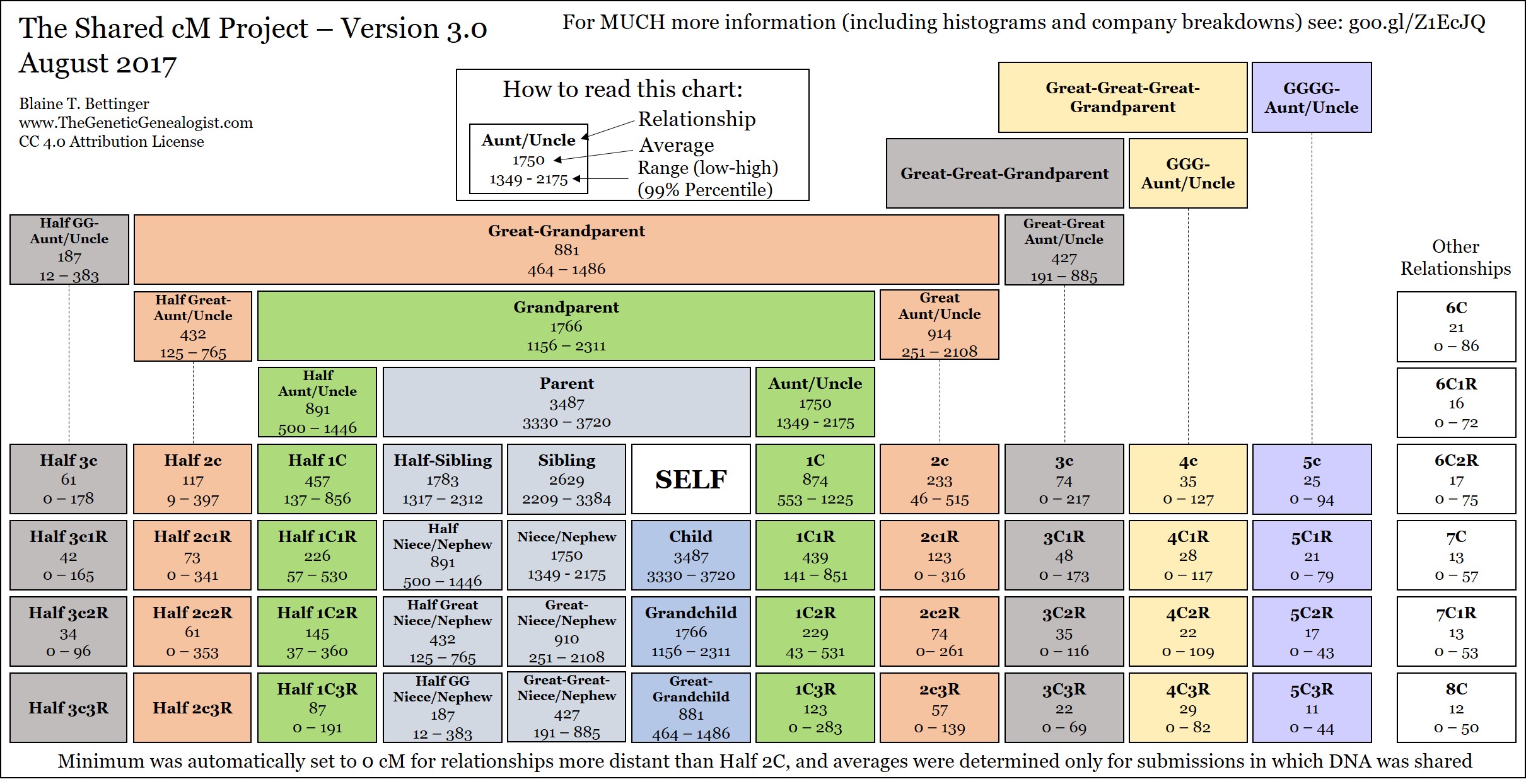
When we look at shared DNA charts like this one produced by Blaine T. Bettinger, we see that two individuals who share a set of great-grandparents (in other words second cousins) share on average 233 cM of DNA (with a range of 46-515 cM). Depending on how many of one's ancestors are from the same endogamous community, this number will be inflated and exaggerated.

In researching the DNA matches of my father and aunt (both the grandchildren of Grover), I see an inflated predicted relationship for most of their second and third cousin matches. Usually, if they are within the predicted range, they are at the upper end of that range. In the fourth cousin list, most of these matches are related to our family several times over but at a much further place in our tree.

4. The challenge

The biggest challenge that I have found relating to endogamy is that it induces a level of despair - or at the very least apathy - in researching my family from Halifax County, Virginia.

With many of my ancestral lines, I am able to identify specific DNA cousins who connect to my family through specific ancestors. But with my DNA matches that come from Grover's family, I can't tell if they are Hites, Tucks, Wilkins, or Elliotts - or some repeated mix of all of them! And more often than not, they have all of these surnames in their family history. So unlike my other family lines, my Halifax County relatives have remained more of a mystery.

When I see a DNA match, I can quickly say - without a shadow of a doubt (and even if they have no tree) - if they have Halifax County ancestry. But, that's usually all I can tell. This is because the Hite, Tuck, Wilkins, and Elliott families have so intermingled within Halifax County with each other as well as with other families that they've produced something of a new amalgam of simply "Halifax."

*****

The challenge of endogamy need not be the despair-inducing, apathy-inspiring thing that I so often allow it to be. DNA tools such as DNA Painter are making it easier than ever to identify which segments of DNA come from which ancestor. If you have encountered endogamous ancestry in your family history, don't give up! Learn from others who have researched their own endogamous communities. 

Genealogy is full of challenges, and endogamy is only one of them. Most of us who are so enraptured by genealogy and family history find solving the puzzle the most satisfying aspect of our research. And what puzzle is more satisfying than a challenging one? 

This post was inspired by the week 2 prompt "challenge" of the year-long series that I'm participating in with Amy Johnson Crow's 52 Ancestors in 52 Weeks.

I hope you'll join me soon as I strive to encounter my ancestors through family history and remember the past made present today.

Monday, January 21, 2019

How to Prepare and Pack for RootsTech


When I'm preparing for a trip - whether it's just to see family or it's a long distance trip - I always feel like I'm forgetting something. And you know what? I usually do forget something!

So to assist not only myself, but also to make sure that you get the most out of your RootsTech 2019 experience, I'm putting together this simple list for preparation and packing for this year's conference.

How to prepare

1. Study the schedule and decide which classes you'll attend

You can view the event schedule here and the class schedule here. Make sure you read the class descriptions and learn about the instructors. Also, if you see a few classes that you've *GOT TO* attend, assume that others feel the same way. Those classes will likely fill up fast, so you should have a back up in case they're full when you arrive to class. Find another class that you'd also be interested in for those spots just in case. There's nothing worse than being turned away from a room and then not knowing where you're going next. Planning will take away this problem!

2. Download the RootsTech app

Why should you use the RootsTech app? Because it'll make your experience so much easier. I used the app last year, and it helped me find classes, make my schedule, and even let me rate my instructors. You can learn more about the app and how you can download it to your device here.

3. Schedule time to visit the Family History Library

The conference is held just blocks away from the famous Family History Library - the world's largest family history library! This may be overwhelming, so make sure to check out their website to figure out what resources you want to prioritize on your visit. After the busy class schedule, you won't have a whole lot of time to be at the library unless you skip classes. So, decide what items at the library you'll access and then use your time at the library wisely.

What to pack

1. The right clothes and shoes

Salt Lake City in February and March is a cold place. Make sure you pack appropriate clothes for your trip. It may snow, so make sure you have gloves or shoes that will work well in snow and ice. Also, remember that your clothes represent you. Are you going to RootsTech for networking and furthering a genealogical career? Or, are you going simply to learn and make connections? The type of clothes you wear should reflect your purpose. In addition, you'll be doing a lot of walking at RootsTech. Make sure you have comfortable shoes that will allow for all those steps!

2. Laptop or notebook for notes

RootsTech is like going to college for a week. You'll be in class after class and there's no way you'll be able to absorb everything you are taught. So, it's best that you have a way to take good quality notes of your classes so that you can look back at it another time after the conference. I'd recommend bringing a laptop if you're a fast typer. This will allow you to take organized notes while your presenters are speaking. You may also want to bring a notebook if you're more of a doodler or note taker that way.

3. Backpack or shoulder bag

You're going to be walking a lot with your laptop and whatever else you're carrying. So, make sure you have a good backpack or bag to carry with you during the conference.

4. Money

When you go to the Expo Hall you are going to want to walk out of there with some goodies. Books, DNA test kits, cool family history stuff! That means you'll either need cash on hand or cash in the bank to make debit/credit card purchases from the many vendors available. Budget for this.

5. Portable charger for mobile devices

Between using your mobile device for the RootsTech app, following new friends on Twitter or Facebook, checking e-mail, and regular use of your phone, you are going to want to make sure you can charge your mobile devices. You can bring your wall chargers with you, but you're going to have a hard time finding wall sockets when you need them. So, this year I've purchased a portable charger to keep me charged up all week long. Two highly recommended portable chargers are the Anker PowerCore 13000 and the Anker PowerCore 20100. It's a wise investment for RootsTech.

*****

RootsTech is a blast! But it's also a whirlwind of experiences, connections, and new discoveries. So make sure that you're prepared for this wonderful trip. I hope these suggestions prove helpful for you and that we can connect at RootsTech 2019! If you've been to RootsTech before, and you notice that I've left out a helpful suggestion for the conference, please make sure to leave a comment below.

After all, RootsTech is a great place if you like me want to encounter your ancestors through family history and remember the past made present.

Saturday, January 19, 2019

The First Time I Heard Her Voice


The first time I heard my Grandma Nora's voice was 13 February 2017.

It was a cold evening and I had decided to finally pull out those old cassette tapes that I had found at my Uncle Art's house. Uncle Art had passed away the previous spring, and in cleaning his house I found a collection of tapes that I had kept in a brown paper bag for safe keeping. I just hadn't built up the courage to listen to the recordings yet.

What would be on them? What if they were just Art's favorite songs? But maybe...just maybe...there'd be recordings of my Grandma Nora.

So I borrowed my dad's old cassette player that he was going to throw out anyway, and that cold evening I decided to throw caution to the wind and see what I might find on those mysterious cassettes. (I later discovered from Tom Perry on Extreme Genes that you should *never* use an old cassette player until first cleaning it. One of the tapes got stuck in the cassette player!)

After not hearing my Uncle Art's voice for so long, here he was again. 

"Okay this is going to be a call to Mother here, in the hospital in Richmond. This will be calling from Manassas here and it's August 10, 6:15pm, that's Monday. Okay hold on....here goes the call!"

I quickly remembered hearing stories of my Uncle Art's love for recording. He would make audio recordings of conversations and thoughts. He was also a photographer, a journal keeper, a man who kept lists. So this didn't surprise me, though it did excite me! What would I hear next?

The first time he called the line was busy, so he tried again at 6:45pm.

"313, please."

Once the connection is made, the nurse hands the phone to my Grandma Nora. And just like that, I'm given a priceless gift that my Uncle Art never expected to give me. The first time I heard her voice.

"Hello?"

"Hi."

"Oh hi Darlin'!" She's so excited to hear from her first born.

"Mrs. Williams?" Art seems almost jokingly formal.

"This is Mrs. Williams!" She replies with a sing-song giggle in her voice.

They talk about how she just had her treatments. My Uncle Art wants to go down to Richmond to see her, but he's not sure if he'll feel up for the trip from Northern Virginia. She talks about the visitors that have come, and her roommate in the hospital. Between her cancer treatments and jamming her finger in the bathroom door (something she mentions in a care-free sort of way), you'd think she'd sound upset, frustrated. But she doesn't. She's jovial. Light-hearted. Youthful. 

"Everything's just fine!" she practically purrs. This is a woman who's clearly spent her whole life thinking of everyone but herself.

"I'd love to see you....I love you. You come when you can, yea, suga'?" Her voice drips with the beautiful non-rhotic sweetness of Virginia.

Sometimes I wish you could just frame a moment; to hold on tight to a particular time spent with someone special. Bottle up the smell of fresh biscuits. Frame the voice of my Grandma Nora. 

In the next recording, Art clarifies that it's 1987. It turns out he did take the two hour trip south after all. To where he grew up, in Moseley, Virginia: an unincorporated area - not quite a neighborhood nor even a town - that hugs the border of Powhatan and Chesterfield counties. 

I'm glad to find out that he took the time to visit my Grandma Nora. That was 10 August 1987 and she she passed away 6 October 1987, not even two months after this recording. 

I was born in the interim - just two weeks before she passed away. I met her only once. One moment with my Grandma Nora. She was so happy to see that I had "Charlie's eyes" - the eyes of my grandfather. She lived long enough to meet me, to see me, but not long enough to tell me her story. 

So every day I grasp at every thread of information, every DNA match, every record, every distant cousin, every story, every photo, every little thing so that I can attempt to paint a picture with words of a woman who gave everything to everyone. Who held on long enough to give her grandson that one precious moment with his Grandma Nora.

I may not have her eyes, but I do have her heart. And I have her giggle.

*****

This has been my first post in a year-long series that I'm participating in with the inspiration of Amy Johnson Crow's 52 Ancestors in 52 Weeks. The first prompt was simply "first." I'll be catching up on the rest of January's prompts, and then hopefully afterwards I'll be on a more regular weekly schedule of blogging about a different ancestor. 

Thanks for joining me with my Uncle Art and Grandma Nora this week. I hope you'll join me soon as I strive to encounter my ancestors through family history and remember the past made present today.

Monday, December 31, 2018

Two Months Until RootsTech 2019!


Well 2018 sure has flown by! It feels like we were just saying goodbye to the last few beach days of the season, and then the trees changed colors, and just as I was getting ready to start thinking about Christmas it was Christmas Eve and my tree still wasn't up! Don't worry though, y'all, I got it up Christmas Eve night just in time...

Suffice it to say, time has gotten ahead of me. And though wishing the time away is never a good thing, there is a perk that comes with us getting closer to the end of February. It means we're closer to RootsTech 2019! In fact, we're just two months away from the largest genealogy conference...and by far the most I've ever felt like a kid in a genealogy candy shop.

*Just* *TWO* *More* *Months!*

So as we're approaching RootsTech, let's look at some of the new developments that have come out about the conference. I'm already pumped about going, but I hope you'll be as excited as I am too!

Featured Speakers

These are the folks we're going to listen to, to learn from, and to collaborate with. They are experts in various genealogical specialties, from genetic genealogy to regional and ethnic studies. They're our friends, our coworkers, and our community's icons. And you'll be together with them for days to connect over our shared passion of family history.

To see the full list of featured speakers click here and scroll down past the keynote speakers to the Featured Speakers section. If you click on a speaker's photo, it'll take you to their short bio. But make sure you also check out the full schedule for the week so you can see all the classes they're offering! Trust me, you'll want to make your schedule before you go.

Keynote Speakers


Our keynote speakers have been announced! We'll get to hear from Patricia Heaton - from Everybody Loves Raymond - on Thursday February 28. On Friday March 1, we'll have Saroo Brierley the author of his biography A Long Way Home that was turned into the successful film Lion. Last, on Saturday March 2, the talented Hawaiian ukulele artist Jake Shimabukuro will take the stage. You can check out more on all three of our keynote speakers here.

Preparing for RootsTech

Not sure how best to prepare for the conference? Check out this video series that will help you with everything you need from getting registered to learning about RootsTech. Now that the schedule is public, and we know who our speakers are, you're all ready to start planning what classes you're attending and when you'll have free time to see other area sites. With such a jam-packed schedule, and so many amazing speakers, you're going to have to manage your time well...and that means preparing beforehand.

In the new year, I'll discuss some of what I'm doing to prepare for RootsTech and what I hope to get out of the conference this year.

*****

Two months may sound far away, but February 27, 2019 will be here before we know it! With each passing day I'm getting that much more excited about the new learning opportunities, and the new and old friends I'll get to see this year at RootsTech. Plus, I hope to get out and see more of Salt Lake City this time around! It's such a beautiful city...and that view!

Who are you most excited about hearing from at RootsTech 2019? Is there a keynote speaker you hope to meet? How are you going to prepare for RootsTech this year?

Whether you're spending New Year's Eve relaxing with family and friends or busily sleuthing in the records of your ancestors, I wish you a blessed evening and a Happy New Year! Keep striving to encounter your ancestors through family history research and remembering the past made present.


*Photo by Jon Tyson on Unsplash*

Thursday, December 27, 2018

Organizing DNA Matches


Some folks are just more organized than others. When it comes to our work space or our home, some of us like to keep some happy clutter...while others have a place for everything. And the more we get serious about our genealogical research, each one of us will have a different organizational style for our work.

Our genealogy will never be finished, nor will we probably ever find *every* record for any given person. And that's even more true when it comes to our DNA records. Each DNA match that we find is a new record of sorts, a new documentation that may serve to reinforce our paper research. So how do we properly organize all of these DNA matches that are forever growing in number?

In this post, I'm going to share one possible way that you can go about organizing your DNA matches, and some of the benefits of keeping your matches organized.

Organization brings clarity

When we first look at our DNA match list - be it on AncestryDNA, 23andme, MyHeritage, or FamilyTreeDNA - our first feeling might be anxiety. AH! SO MANY matches! Particularly for those with colonial American ancestry, it's common to have thousands of matches at an estimated fourth cousin or closer level. That can be overwhelming!

After we get past the shock of the fact that we're connected to thousands of people in our match lists, we need to get to some work to narrow down our connections. This means we need to organize ourselves somehow. But before I get to that, we should talk about the "why" of it all.

Organizing our DNA matches gives us clarity of vision. It makes sure that we know what we're looking at. When we first look at our DNA matches - without organization - it can be like standing at the edge of a vast forest of trees. What lies within? How do we get through? We have no idea from our vantage point. But...if we look from above - from a bird's eye view - we'll have a view that tells us the best way forward.

When we organize our DNA matches, we can make our match list more manageable and useful for us. Instead of being just a list of names, we'll see our list as a helpful tool for our genealogical research.

Getting organized

When we're surrounded by clutter, even sorting things out into piles can make all the world of difference! And when it comes to our DNA matches, that initial work can be done with the tools that our DNA testing companies give us.

With AncestryDNA, there are two tools which I first recommend everyone use: stars and notes. I recommend everyone start initially by determining which matches are on the paternal line and which are on the maternal line. Then choose which side you're going to star. After this, you can click on shared matches and star all of the closest matches that are shared with those other starred matches. It's not fool proof (you may match someone through both your mother and father) but for most folks it'll be a good place to start.

After you have most of your closest matches starred - or not starred - then you can add notes. I rely on these notes because they remind me of how a person matches the DNA test taker whose results I'm working on. Once I figure out how this person is connected, I also add them and their line into the tree associated with the DNA test. It will make your family tree grow pretty fast, but trust me it will pay off in the long run. It makes determining those more distant DNA matches so much easier!

With this first level of organization, you'll have starred matches and notes on all of your closest DNA matches. And, you'll also have all of your proven DNA connections as people within your family tree as well.

Charts?! Sheets?! Say it ain't so!

So far, everything I've shared with you is what I had been doing for the last few years. I thought to myself - self - you've done good! I thought this was enough to keep my DNA matches organized for the work I was doing. But then...I realized "good" wasn't enough! I want to do excellent work. So I need excellent organization. And one way to have excellent organization is to use charts.

I must admit up front that I do not keep charts and sheets for matches of every family line of my family. I actually only have begun this work on two of my lines. Why only two? Well, these are the lines that I'm most preoccupied with right now. I'm sure I'll do this for more, but for now this is serving to keep me organized and this has been paying off. So how do I organize my charts, and what do I use?

I'm a big believer in Google for my research. I use Google Docs for writing notes for myself and Google Sheets to make free spreadsheets. The huge perk is that they automatically save as I work. For Google Sheets, I am able to make charts that document the DNA connections for my matches. I use these sheets for family lines that I'm looking to get greater clarity in, or that I'm trying to prove or work further back past a brick wall. Since I have tested many family members and have access to some of our close and distant cousins, I can note in Google Sheets how closely each DNA match connects to each of these individuals.

How I use Google Sheets

In the first column in Google Sheets, I note the DNA match name and/or username. The next columns are for your DNA tests that you administer that you want to compare to this user's DNA. For example, when I'm looking at my Williams & Adams cousins Google Sheet, I compare each AncestryDNA user to my aunt, my father, two of my dad's second cousins, my third cousin, and two fourth cousins. You can certainly use this format even if you're only comparing each AncestryDNA user only to your DNA test results, but it gets increasingly helpful when you're comparing to multiple sets of results.

The next column I label "notes" and I use this to note how exactly this AncestryDNA user connects to the family line I'm researching. An example of one user's connection to my Adams family, I wrote, "William Adams & Mary Moore; William; Motier; William E; Linwood C; Linwood P" in the notes column. This shorthand represents this particular AncestryDNA user's descent from the ancestral couple I am studying. It also lets me know the line in my family tree to look at when I want to look at this match. It also shows me which children of my focus couple have given the most matches. This is particularly important in doing descendancy research with your DNA results

The last column I use to include a link to the AncestryDNA user's profile. From their profile page, I can contact them and I can also check back to see if they administer any other DNA test results. I can also look back to see if they've increased the information in their family tree. Also, I might want to compare this user to another person whose DNA results I now have access to.

In each row, I look at a different AncestryDNA user. In each column, I write the amount of DNA that these two people share. I get this number from the "i" symbol next to each match on AncestryDNA. For example, I might write "54.9 cM across 4 DNA segments." This is helpful because later I can look at my Google Sheets and see how large of a connection actually is between two individuals. It's much more specific than simply an estimated fourth cousin.

I use this format for two family lines I'm researching: the Stratton family and the Williams & Adams family from Powhatan County, Virginia. My Stratton Google Sheets form has - as of 27 Dec 2018 - 63 AncestryDNA test results organized and compared to four people. My Williams & Adams form has 49 individuals whose DNA is being compared to seven people.

*****

Before I started making Google Sheets for focusing and organizing my research, I never thought too much about organization. Because I hadn't yet reaped the fruit of good organization. But now I have a visual to aid in my research. I have a resource for my DNA match list, and I don't have to go searching through the brambles of my match list anymore. 

This is only one small way that you can begin to organize your DNA matches. This is something that has helped me, but I'm sure there are countless different ways that you can organize your own matches. The important thing isn't how you organize, but that you do take the effort to tame your match list and to make it more manageable for you. So get to work, y'all!

Do you find your DNA match list too much to handle? How do you organize your DNA matches? How has organization helped to improve the quality of your genealogical research?


*Photo by Oscar Chevillard on Unsplash*

Let's Connect at NGS 2022!

The National Genealogical Society Family History Conference is back in person this year! And y'all I am so ready to meet face-to-face!...